

Who Invented the Piano?
Just like people, the piano has its own family tree, with a rich lineage that can be traced back through many generations spanning 500 years.
The modern piano was invented around 1698 by Bartolomeo Cristofori. His invention was not created out of thin air, but was a variation of keyboard instruments already in wide use in Europe, specifically, the clavichord and harpsichord. Below, let’s take an overview of the evolution of these instruments, starting with the clavichord.
CLAVICHORDS
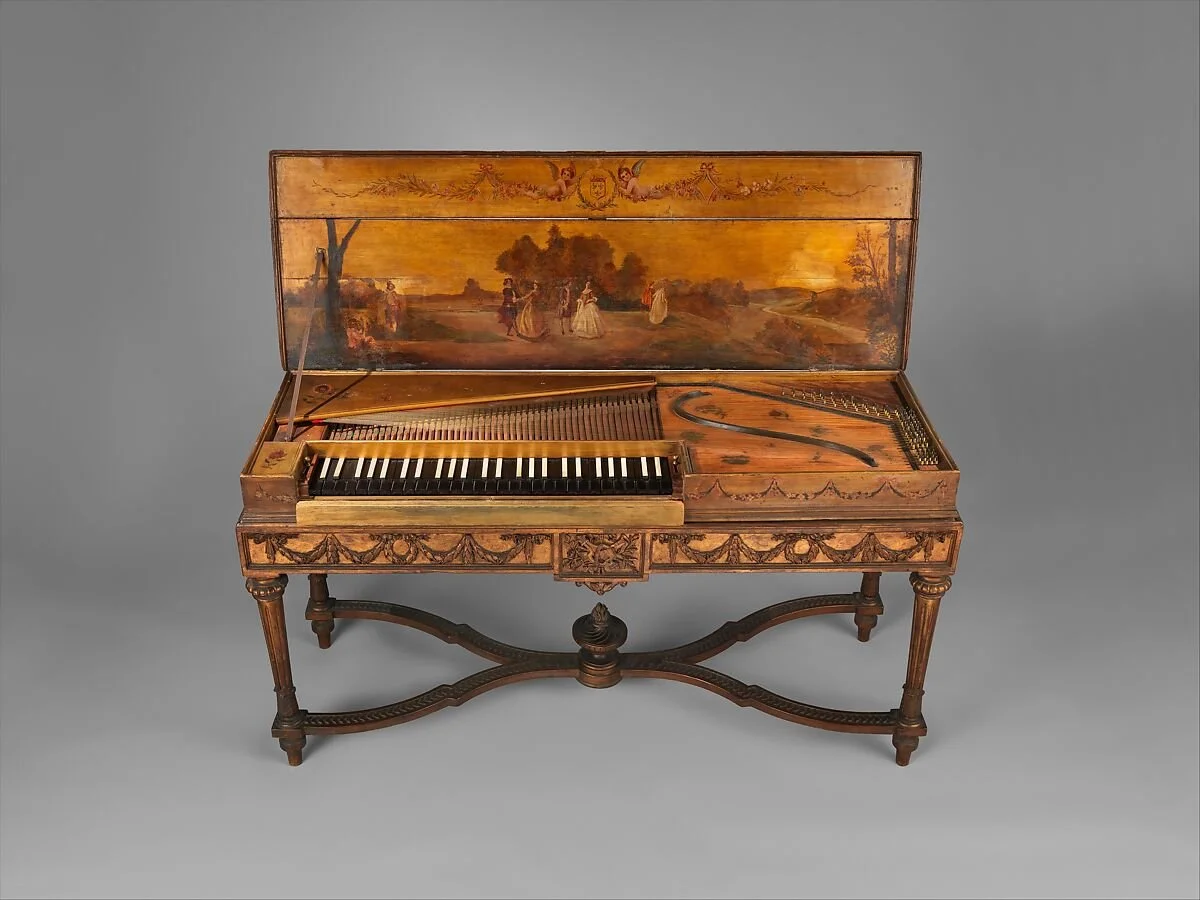
Clavichord. Photo credit: Metropolitan Museum of Art.
The earliest keyboard instruments with strings were the clavichords, dating back to the early Renaissance, approximately mid-14th century. Due to their subdued sound, clavichords were primarily used for domestic entertainment or as practice instruments rather than for public performances. The strings, made of brass or iron, were struck by small metal blades (tangents), enabling modest control over crescendos and diminuendos.
Clavichords were of practical use to composers, providing them with an instrument of modest dimensions for their personal use. For instance, Franz Joseph Haydn composed The Creation on a clavichord.Wolfgang Amadeus Mozart used his clavichord to write his operas, The Magic Flute and La Clemenza di Tito, as well as his Requiem Mass and a Masonic Cantata.
HARPSICHORDS
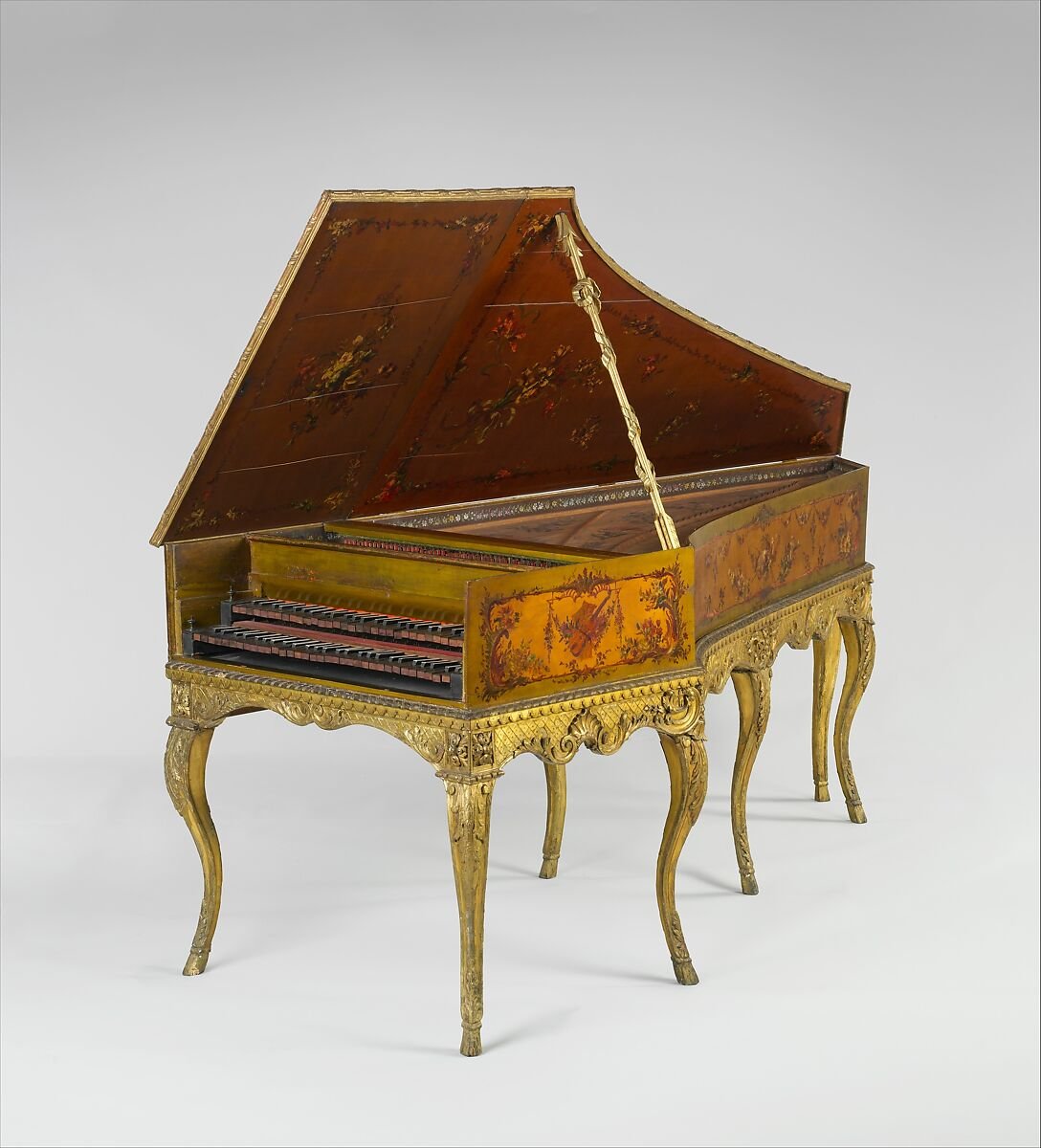
Harpsichord, 1742. Photo credit: Metropolitan Museum of Art.
By comparison, the earliest harpsichords emerged around the same period, but what made them special was that their strings were not struck, but plucked with quills. This method produces a brighter, louder sound, rich with overtones and harmonics, giving a distinct tonal character of brilliance. The frames of harpsichords and modern pianos are essentially large harps that have been mounted horizontally and set on a stand.
Unlike clavichords, the harpsichords were built more robustly and often featured two keyboards that controlled two separate sets of strings. This two-tiered construction gave them more versatility.
Harpsichords were very popular for public performances and were favored by renowned composers, including J.S.Bach, Handel, and Scarlatti, who used them both as solo instruments and in ensembles.
Haydn, Mozart, and Clementi, in their early youth, took their first lessons on harpsichords, but by their twenties had transferred their creative focus to the newly popular fortepiano.
The clavichord and harpsichord incorporated two existing technologies: from the pipe organ, a wind instrument dating to the 12th century (with origins to 350 B.C.), came the prototype of the modern keyboard. From the hammered dulcimer, a string instrument originating thousands of years ago in the Near East, came the method of playing on tightly stretched strings with mallets. Combining the organ’s keyboard with a dulcimer-type string instrument resulted in the creation of the clavichord, as well as the harpsichord with its plucked strings, and various other related experimental instruments of the era.
FIRST PIANO WITH HAMMER ACTION
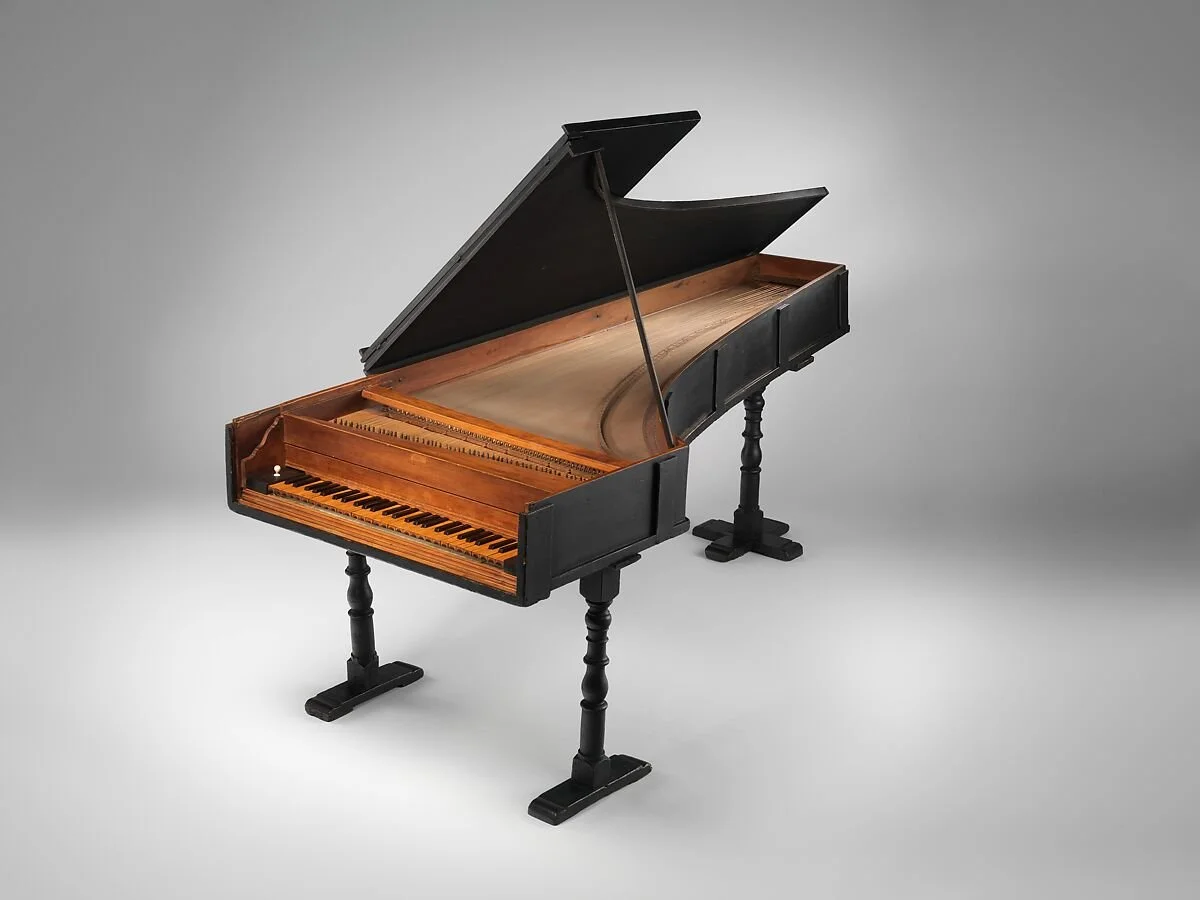
First Piano, circa 1700, invented by Bartolomeo Christofori. Photo: Metropolitan Museum of Art.
Bartolomeo Cristofori (1655-1731), an inventor of musical instruments in Padua, Republic of Venice, is credited with building the first hammer action applied to a harpsichord, creating a new instrument that evolved into the modern piano. Cristofori titled his new instrument, “un cimbalo di cipresso di piano e forte”, freely translated to ‘a musical instrument made of cypress wood playing soft and loud.” Cristofori’s first piano was built by 1698, with the first known sales receipts dating to 1700.
Cristofori’s pianos closely resembled harpsichords in weight and construction, with wooden frames and low string tension. Unlike the harpsichord, which produced a consistent volume, Cristofori’s hammer-action allowed musicians to control the volume with their touch, giving more expressive freedom. The Italian words 'piano' meaning soft, and 'forte' meaning loud or strong, combined to name this groundbreaking instrument as either pianoforte or fortepiano. By the early 19th century, it was commonly shortened to simply 'piano'.
When a string is struck by the hammer, it vibrates until the player releases the key, at which point a damper stops the sound. Cristofori realized that the hammer needed to return immediately; otherwise, it would remain in contact with the string, muting the sound. To address this, he created an action that bounced off the strings, allowing for quick, repeated play. This clever innovation was improved over the next three centuries.
However, Christofori’s new fortepiano wasn’t an instant favorite; it was quite expensive to produce, and some musicians complained the sound was too soft and dull compared to the harpsichord.
FORTEPIANO IN THE 18TH CENTURY
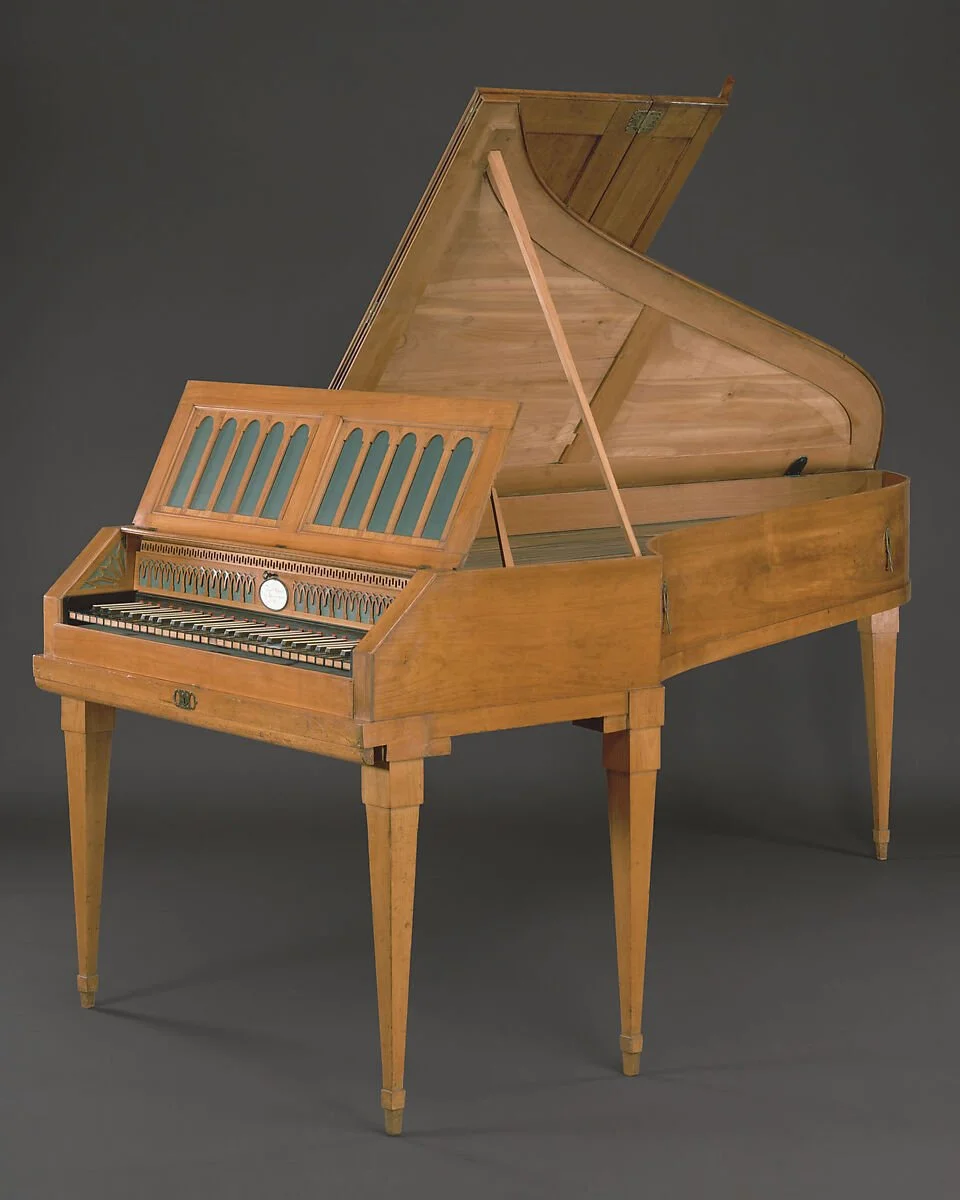
Fortepiano by Ferdinand Hofmann, 1790. Photo credit: Metropolitan Museum of Art.
Cristofori’s invention was publicized by Scipione Maffei, who provided diagrams illustrating its mechanisms. Gottfried Silbermann (1683-1753), the German builder of pipe organs and other keyboard instruments, used these diagrams to begin building his fortepianos. Silbermann also invented a prototype of the sustain pedal that lifted felt dampers off the strings, allowing them to freely vibrate. This hand-operated lever would later be replaced by a foot lever located underneath the piano. By pressing the sustain pedal that continued those tones, a pianist could lift their hands to other registers without an interruption of that sound.
When Silbermann showed his new instruments to J.S. Bach, he was upset by Bach’s criticisms of the weak treble and stiff action. However, Silbermann took Bach’s observations seriously and made improvements that later won Bach’s approval.
Silbermann influenced other builders who continued to innovate, including his nephew and pupil, Johann Andreas Silbermann, Johannes Zumpe, Americus Backers, Nannette Streicher, as well as Anton Walter and Johannes Andreas Stein, whose pianos were used by Mozart, Haydn, and Beethoven.
INNOVATIONS IN THE 19TH CENTURY
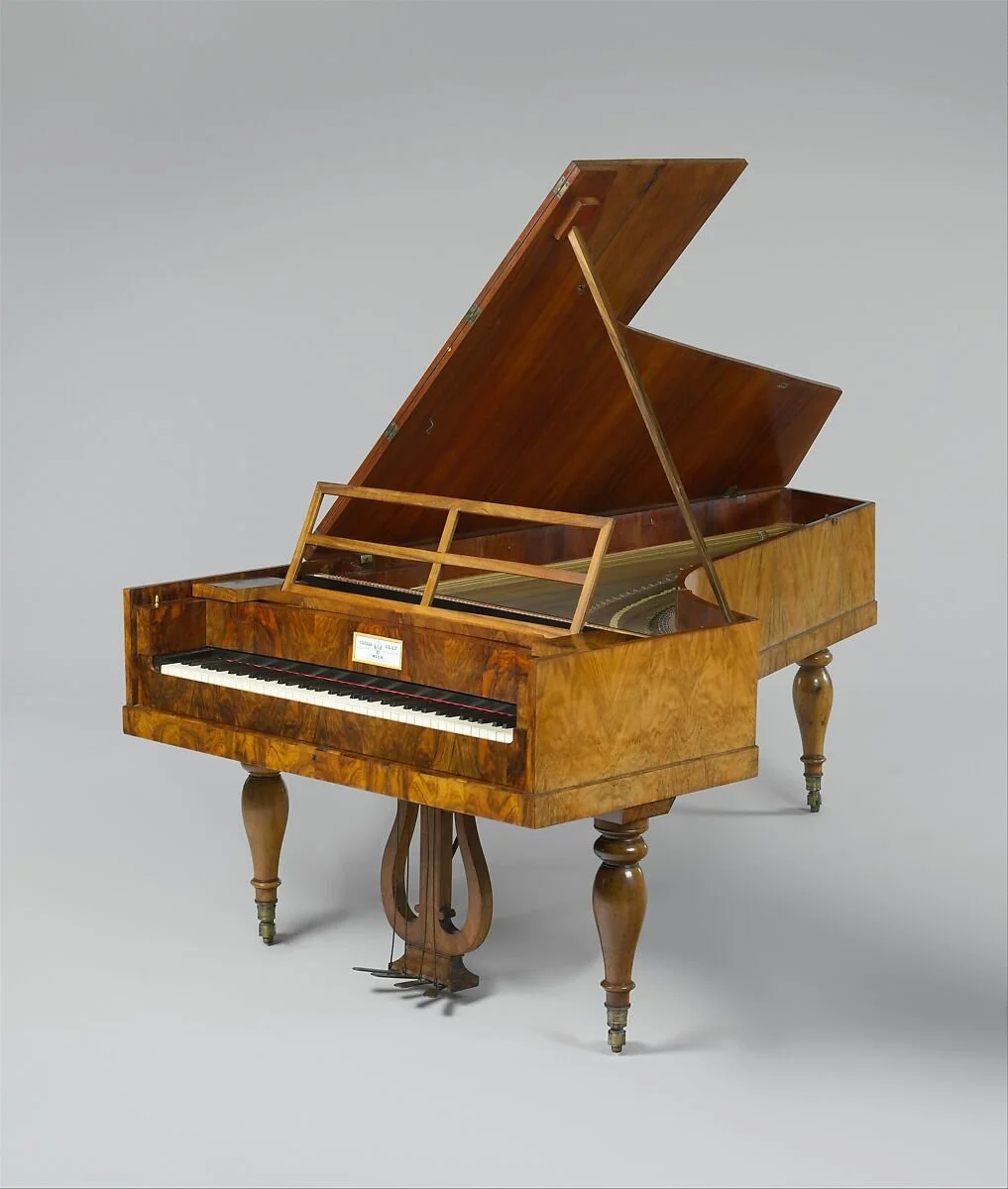
Fortepiano by Conrad Graf (1782-1851. Photo: Metropolitan Museum of Art.
As early as 1777, the English firm of John Broadwood was manufacturing larger pianos with more substantial cases and frames that produced a more powerful tone that was admired by Beethoven. The Viennese piano builders were quick to follow suit.
With the technological advances of the Industrial Revolution, the piano also underwent transformations. Piano strings improved in quality, and wooden frames were replaced with massive single-cast iron frames invented by Alpheus Babcock that enabled the strings to be stretched and held with greater tension. This, in turn, allowed for greater volume and sonority. Additionally, the five-octave range of 18th-century fortepianos expanded to over seven octaves by the mid-19th century.
Pleyel and Érard, two renowned piano manufacturers based in Paris, thrived throughout the 19th century. Their pianos were favorites among legendary composers such as Chopin, Liszt, Mendelssohn, and later Saint-Saens, Debussy, Ravel, as well as esteemed concert pianists such as Cortot and Paderewski.
Among the innovations of the 19th century were Sebastien Érard’s invention of the double escapement action in 1821, which allowed for faster repetition of the hammer action and, in turn, led to more virtuosic compositions from composers of the era.
Hammers with leather or cotton covers were replaced with firm felt, expanding the range of dynamics. Cast iron frames grew larger and heavier, enabling string tension up to 20 tons and thicker, stronger strings.
The introduction of upright pianos with strings perpendicular to the keys made pianos more affordable to middle-class consumers and greatly expanded their use in homes worldwide.
The piano manufacturing firm of Steinway, with factories in both New York and Hamburg, Germany, improved the double escapement repetition action to create the fastest repeated action of any piano. In addition, the tubular metallic action frame provided superior strength and stability. Steinway’s copper-wound bass strings also greatly enhanced sonority.
UNPARALLELED VERSATILITY
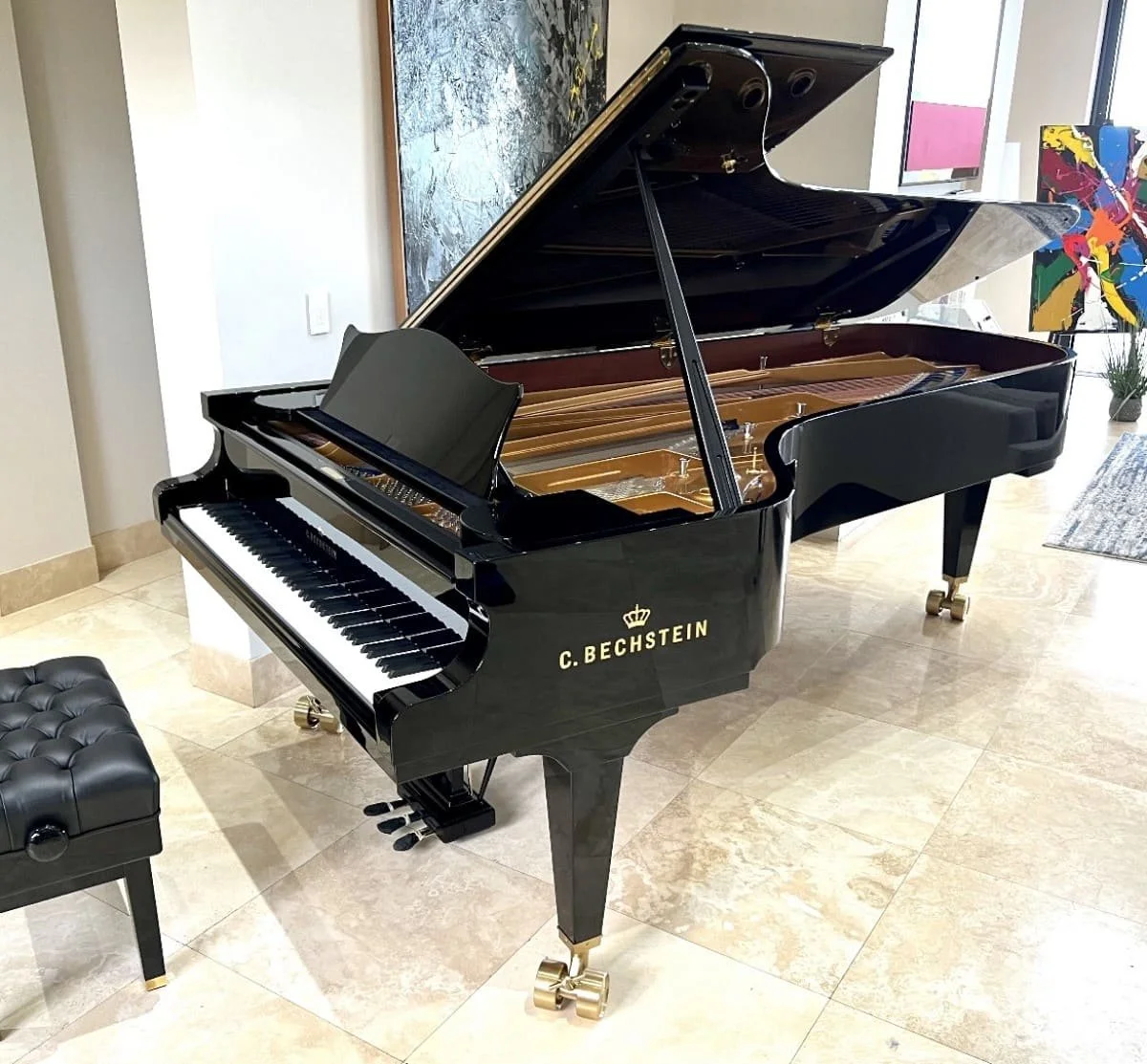
C. Bechstein C-282 Concert Grand Piano. Photo credit: My Perfect Piano.
The piano has been the creative focus of the greatest composers of the past three 300 years, resulting in a vast repertoire of masterpieces that continue to be performed to this day in homes and concert stages around the world.
The modern piano remains as popular as ever and is likely to be at the center of musical expression for many more centuries. With 88 keys and dynamics that range from delicate pianissimo to powerful fortississimo, the modern piano offers an expansive orchestral range and expressivity that can adapt to every genre of music, from classical to jazz, and every popular style.
The piano can stand alone heroically as a solo instrument on concert stages around the world, and just as effectively serve as an ensemble instrument to accompany singers, instrumentalists, and choirs, making it the most versatile instrument in the world.