

Pianos & Harpsichords in Colonial America
Before the piano became a popular feature in homes and concert halls throughout North America, the harpsichord was the treasured centerpiece of wealthy homes in Colonial America. As a symbol of elegance and social standing, the harpsichord, along with the smaller spinet, served as a main source of family entertainment during that time, long before the days of radio and television.
The harpsichord strings are plucked by a small plectrum, originally made of a quill. Harpsichords were used both for ensemble, accompaniment, and solo performance. Harpsichords had two sets of strings, both tuned to the same pitch, or with another set if stings sounding an octave higher at the 4’ register. By contrast, spinets had shorter strings, with one string per note.
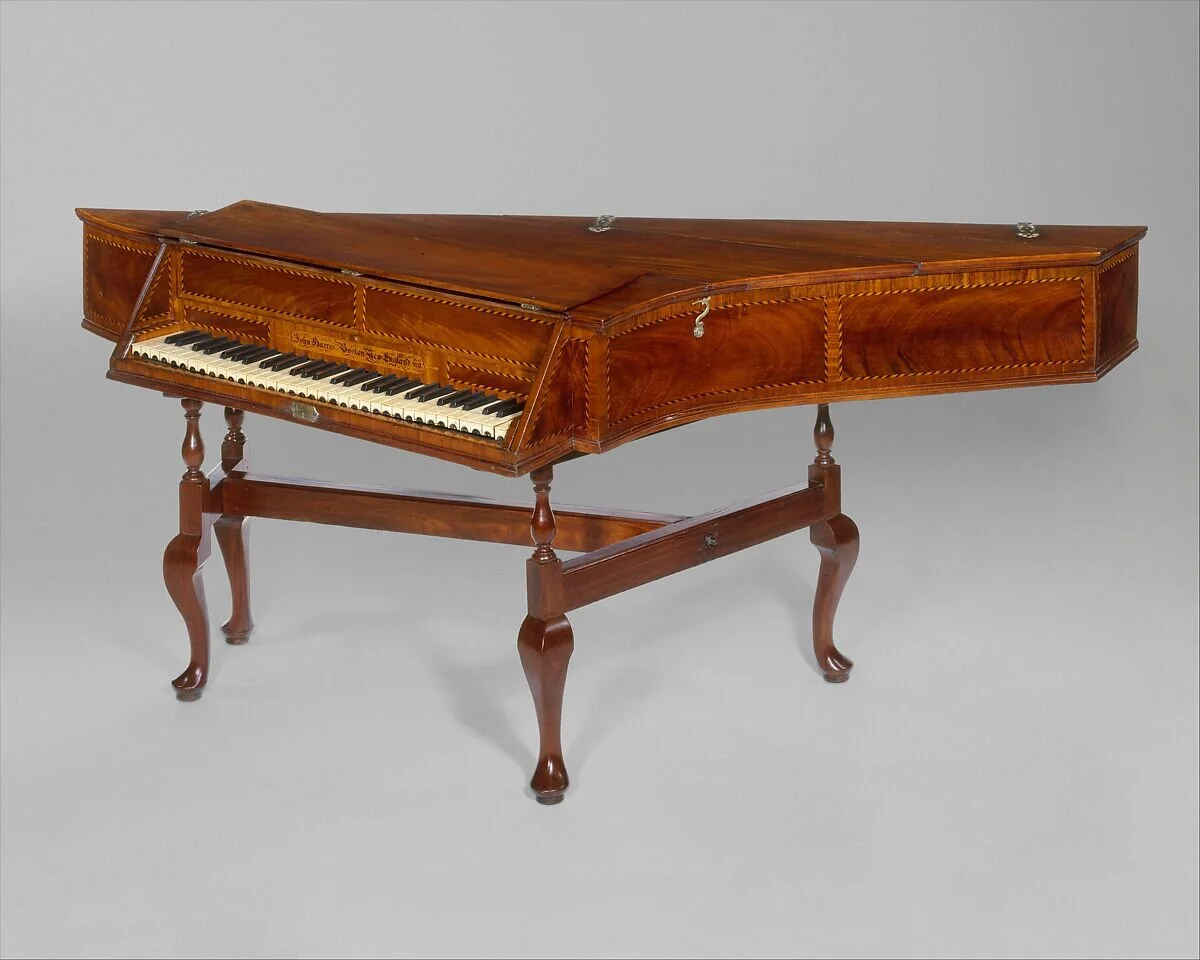
John Harris, 1769, a Bentside spinet harpsichord. Photo credit: Metropolitan Museum of Art.
The construction of the first generation of fortepianos (as early pianos were called) was directly modeled on the harpsichord; the only significant difference being that the quill-tipped plectra used to pluck the strings by the harpsichord were replaced by the hammer action of the fortepiano.
The majority of harpsichords and spinets in colonial America were imported from London. References to harpsichords in America date back to the 1760s. One of the first entrepreneurs was John Harris, a skilled harpsichord and spinet maker from London who moved to Boston’s North End in Massachusetts. He had previously worked in London’s Red Lion Street around 1730, where he registered a patent for “a new invented harpsichord”. His instrument featured only unison stringing and an octave-coupling mechanism, showcasing his innovative approach.
Evidence of the harpsichord in America is also found through the South Carolina Gazette of Charleston, dated August 18th, 1775, that advertised “extraordinary harpsichords” for sale. It's also interesting to note that the very first pipe organ—considered the ‘grandfather’ of keyboard instruments—was imported from England to Philadelphia much earlier, as far back as 1703.
GEORGE WASHINGTON’S COLLECTION
In 1761, George Washington purchased a spinet, a smaller single-keyboard version of the harpsichord, for his step-daughter, Martha Parke Custis. Music lessons among the elite of Colonial America were considered a requirement for a complete education that would signify cultural sophistication and higher social status.
Washington also purchased a “grand” harpsichord with two manuals in 1793 for his adopted grand-daughter, Eleanor “Nelly” Parke Custis. And in 1797, he purchased an additional “grand” harpsichord with a 5-octave range from Longman & Broderip of London. It was delivered to the President’s House in Philadelphia in 1793 and later moved to his Mount Vernon residence in 1797.
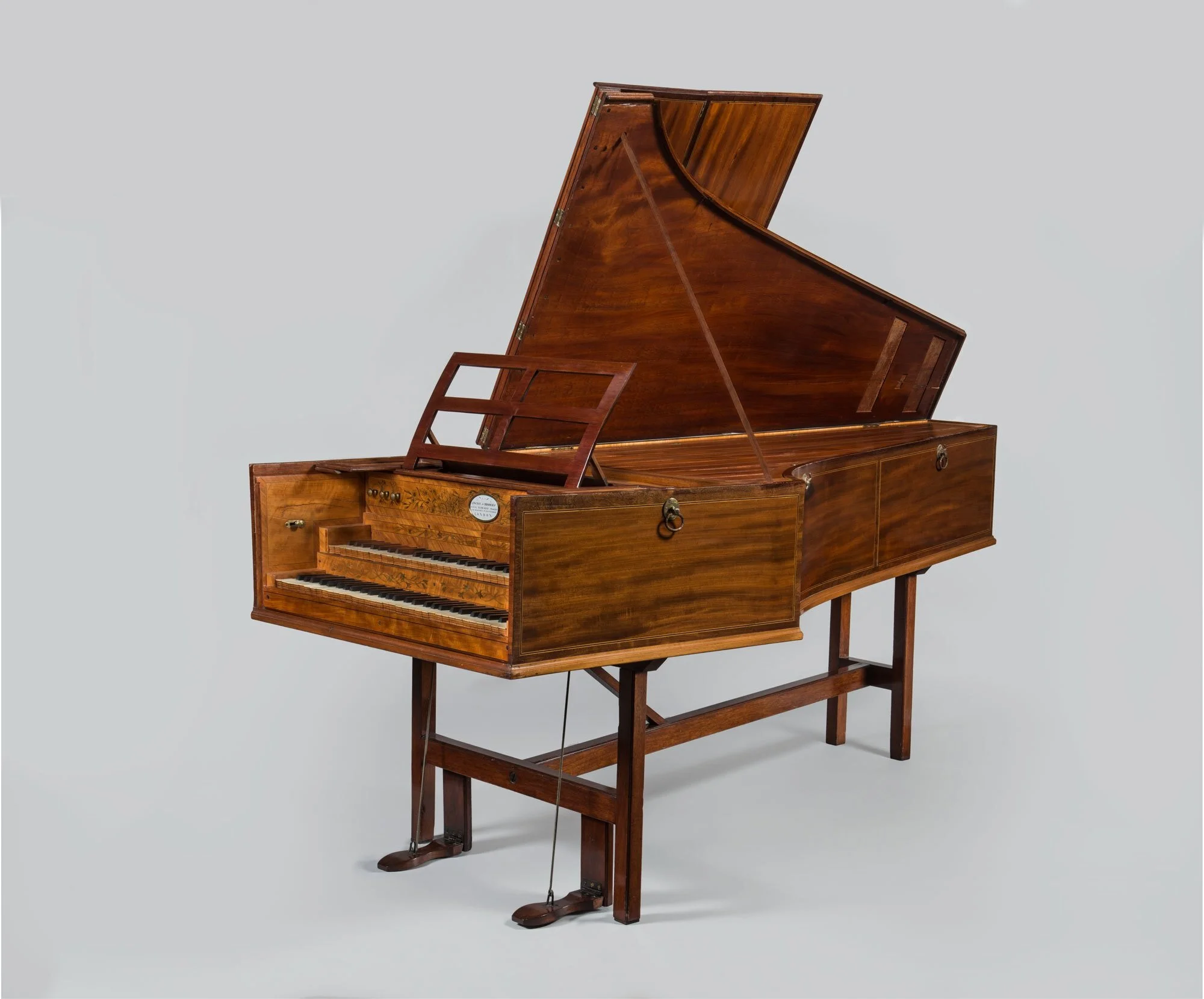
Longman & Broderip harpsichord, 1793, owned by Washington. Photo credit; Mount Vernon Museum.
Dodds & Claus were important piano manufacturers based in New York City. Their production included pipe organs, harpsichords, and fortepianos. Washington acquired a Dodds & Claus square piano in 1789, and he also owned a Schoene & Vinsen square pianoforte, made in London, although the fate of that particular instrument is unknown.
THOMAS JEFFERSON’S COLLECTION
Thomas Jefferson, in addition to his pivotal role in the founding of the country, was a skilled violinist who purchased harpsichords for his wife and daughters. As a multifaceted inventor in his own right, Jefferson took a keen interest in the construction of keyboard instruments.
Jefferson owned a one-manual harpsichord crafted by Jacob Kirchman of London in 1762. The instrument was inscribed, “Jacobus Kirchman Londini Fecit 1762,” and many harpsichords in colonial America were imported from that same London workshop. Excellence and reliability of workmanship were a top value to Jefferson, and according to Dr. Charles Burney, a renowned organist and music historian who befriended Jefferson, the instruments of Kirchman had " sent Harpsichords to every part of the Globe where the English have any commerce, and never has heard of the wood-work giving way."
In 1771, Jefferson purchased a fortepiano from Hamburg, Germany, for his future wife, Martha Wayles Skelton, whom he married the following year. Jefferson lived through the technological and musical transition period from harpsichords to fortepianos, and in addition to his harpsichords, he purchased a fortepiano through his London agent, writing;
“I have since seen a Forte-Piano and am charmed by it. Send me this instrument then, instead of the Clavichord: let the case be of fine mahogany, solid not veneered, the compass from Double C to F in alt, and plenty of spare strings: and the workmanship of the whole very handsome and worth of the acceptance of a lady for whom I intend it.” [his fiancée, Martha.]
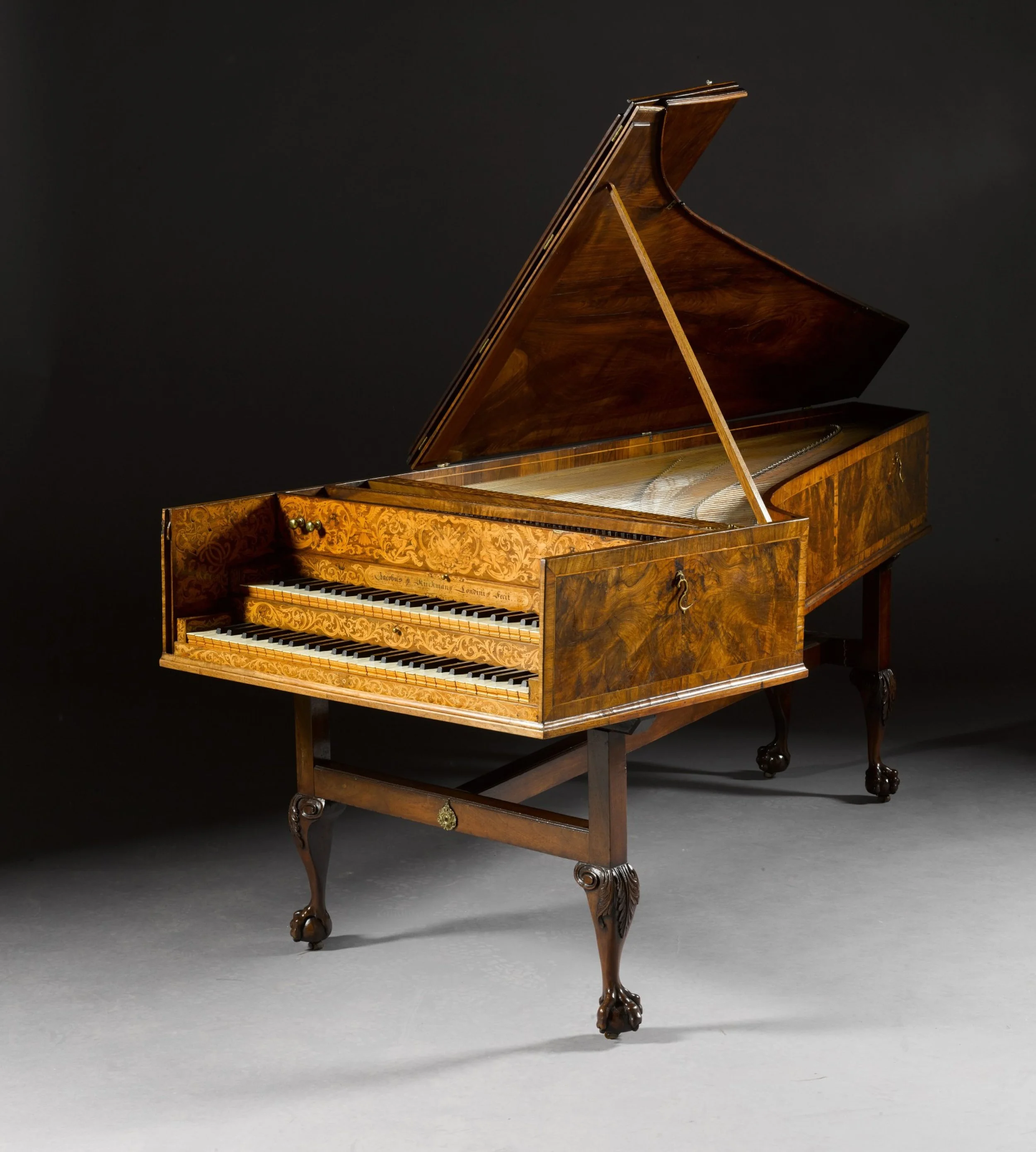
Jacob Kirchman grand harpsichord of London, 1760, similar to one owned by Jefferson. photo credit: Sothebys.
In 1783, Jefferson purchased a clavichord for his daughter Martha, costing three pounds, and in 1786, Jefferson purchased a Jacob Kirckman double-manual harpsichord, made of solid mahogany. Yet another harpsichord was purchased by Jefferson for his second daughter, Maria, in 1798, for $40, or about $1,300 in today’s purchasing power.
Jefferson additionally purchased a “Portable Grand” in 1800, measuring 3’4” x 3’6” x 15”, consisting of 5 and 1/2 octaves of perpendicular strings for $264.00 by the inventor John Isaac Hawkins, an Englishman who lived in Philadelphia. As Jefferson wrote, his purchase was "partly for it's excellence & convenience, partly to assist a very ingenious, modest & poor young man, who ought to make a fortune by his invention." Hawkins was an inventor of various mechanical devices but knew little about keyboard instruments, and Jefferson was obliged to return the instrument after two years for repairs (apparently it could not stay in tune). But Hawkins was the first builder to use iron in fortepiano frames, and that would have lasting consequences for the evolution of the piano.
Jefferson was also interested in purchasing a small pipe organ built by Robert Carter for installation in the entrance hall of Monticello. For whatever reason (perhaps the limited physical logistics of the space), this plan never came to fruition.
JOHANN GOTTLOB KLEMM
An important craftsman of keyboard instruments in America was Johann Gottlob Klemm (1690-1762), often spelled Clemm, who may have been an apprentice to G. Siblermann, a prominent builder of keyboard instruments and pipe organs in Germany. Emigrating to the United States in 1733, Klemm settled in Philadelphia in 1736. Three years later, in 1739, he made a spinet, a small polygonal harpsichord with a single keyboard, which is the earliest documented keyboard instrument made not in Europe but in America.
The spinet is often referred to as a bentside spinet because the frame and strings were ‘bent’ to an oblique angle to the right, at a 30-degree angle to the keyboard, with an overall shape that was approximately triangular. Spinets were less expensive compared to double-manual “grand” harpsichords, with a less brilliant resonance, and consequently, they were regarded as an instrument for private households rather than public performance.
The Metropolitan Museum of Art in New York City is in possession of an exceedingly rare spinet made by Clemm; “This is the earliest known spinet [1739] made in America and the only instrument known by Johannes Gottlob Clemm. Its bent side, of solid wood rather than veneered, suggests the influence of continental rather than English spinet design. Of eighteenth-century date, the stand is apparently original to the spinet.”
JOHN HARRIS
John Harris, son of the harpsichord and spinet maker, Joseph Harris, built a spinet piano in 1769 that was noted in the Boston Gazzette; “A few days since as shipped for Newport, a very curious Spinet, being the first ever made in America, the performance of the ingenious Mr. John Harris, of Boston, (Son of the the late Mr. Joseph Harris, of London, Harpsichord and Spinet Maker), and in every respect does Honour to that Artist”.
Little is known about Benjamin Bucktrout (1744-1812), an English cabinetmaker originally based in London who was active in Williamsburg, Virginia, during the late 18th century. He emigrated to Virginia in the 1760s-70s, where he specialized in repairing harpsichords in Williamsburg. Bucktrout’s advertisement in the Virginia Gazette, January 8th, 1767, declared, “Spinets and harpsichords made and repaired,” giving evidence to the growing importance of keyboard instruments in America.
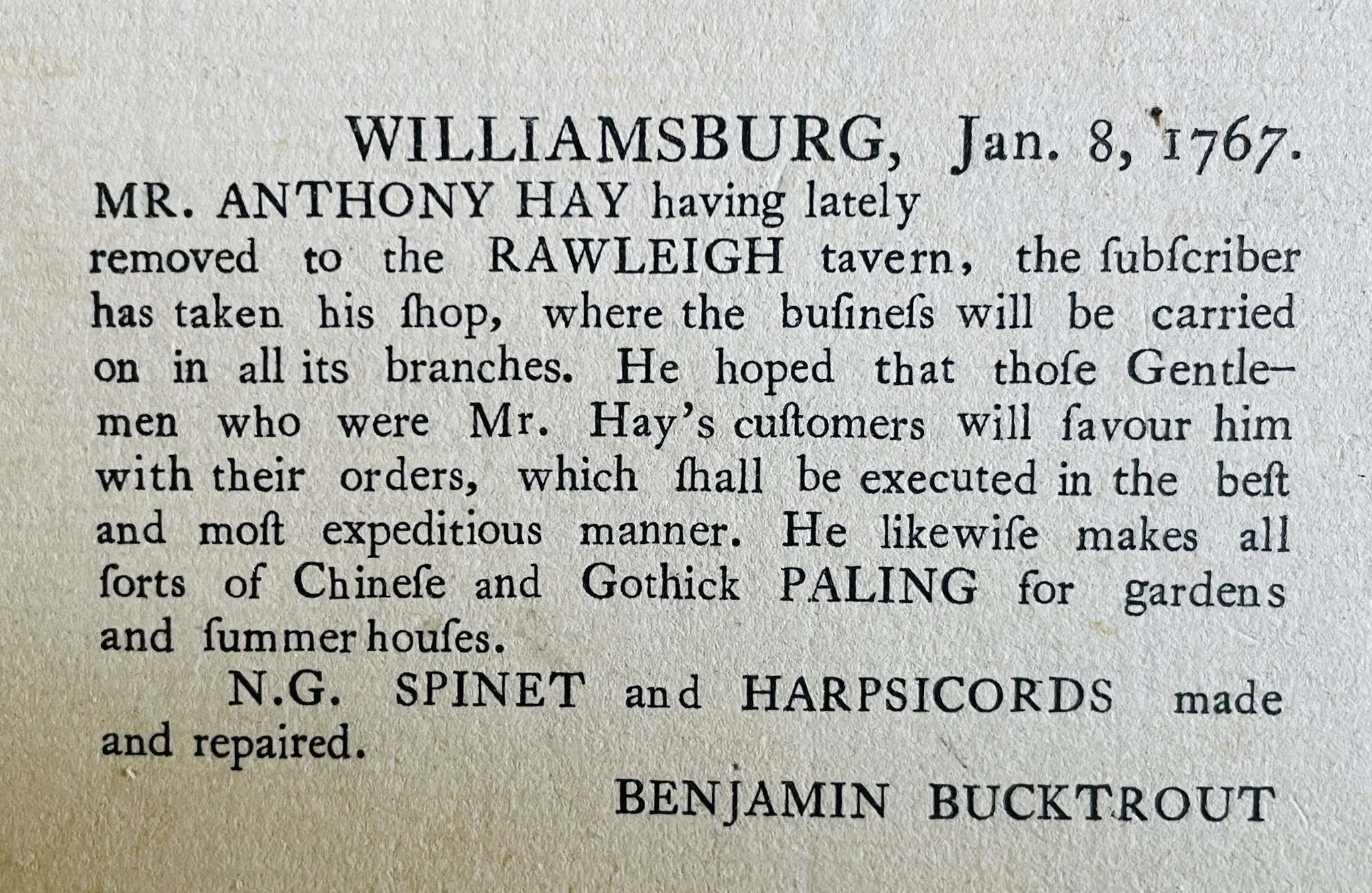
Virginia Gazette, 1767.
TRANSITION TO PIANOS
During the first two decades of the 19th century, the piano quickly replaced the harpsichord as the preferred instrument. This dynamic era of the Industrial Revolution in America also saw the rise of many piano makers. One notable figure was Christian Frenderick Lewis Albrecht (1788 - 1843), whose pianos contributed to this fast-paced musical development.
Piano manufacturing in the United States has a rich history that began in Philadelphia, which was the center of production from 1775 through the 1830s. During this period, the craft was thriving with many talented artisans. By the mid-19th century, New York and Boston emerged as leading centers of production, showcasing the evolving innovations in piano making. These very first instruments were crafted primarily by German immigrants.

Dodds & Claus, square piano, 1781, similar to Washington’s. Photo credit: Met Museum of Art.
The first commercially manufactured piano in the United States was built by a German immigrant, John Behrent (birth? - 1780), in Philadelphia in 1775. Behrent advertised his “Piano Forte” in the Pennsylvania Packet:
“JOHN BEHRENT,
Joiner and Instrument Maker, living in Third-street, continued in Campington, directly opposite Coates’s Burying-ground,
HAS just finished for sale, an extraordinary instrument, by the name of PIANOFORTE, of Mahogany, in the manner of a harpsichord, with hammers, and several changes. He intends to dispose of it on very reasonable terms; and being a maker in such sort of work, and a new beginner in this country, he requests all lovers of music to favour him with their custom, and they shall not only be honestly served, but their favours gratefully acknowledged, by their humble servant, JOHN BEHRENT.”
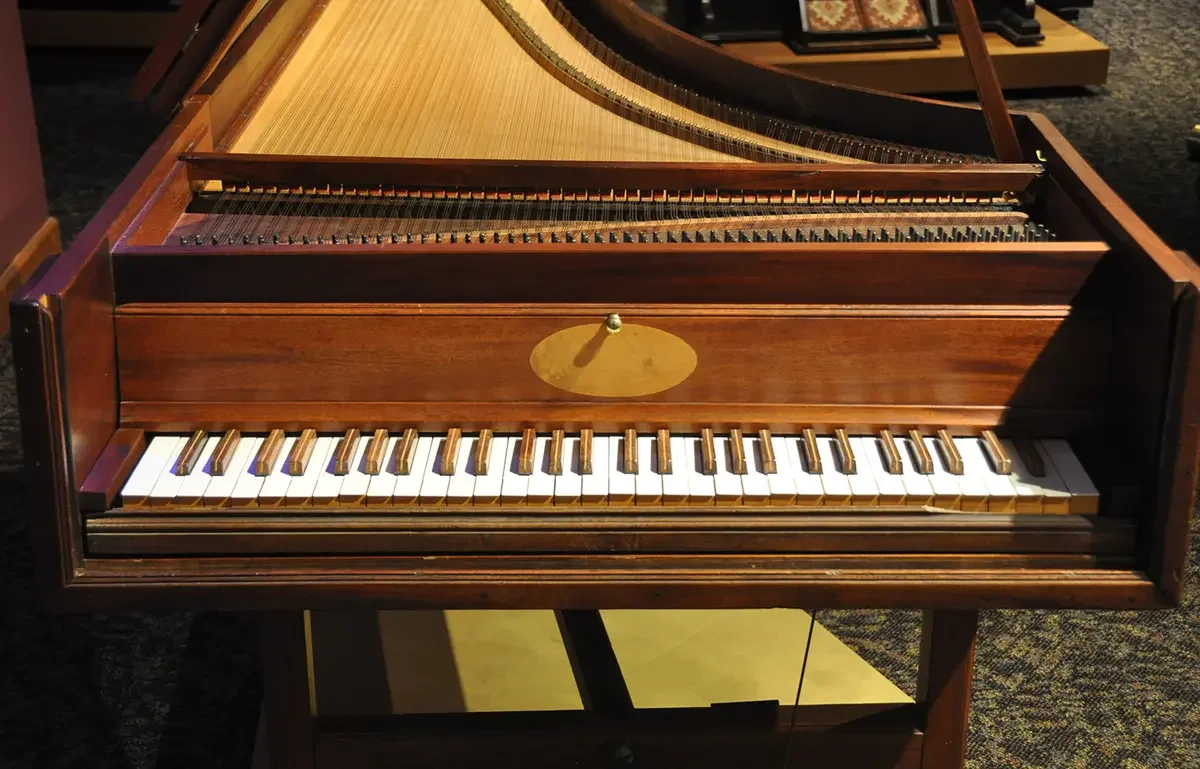
Behrent pianoforte. Photo credit; The Epoch Times
Charles Albrecht (1760 - 1848) was a German immigrant to America who was producing pianos by 1791. At least 20 of his pianos are still in existence, and examples can be found at the Metropolitan Museum of Art in New York City (not on display), the Historical Society of Pennsylvania, and the Philadelphia History Museum at the Atwater Kent. By 1792, Albrecht advertised “TWO new and elegant PIANO FORTES which he will arrant to be good.” Albrecht’s business manufactured more than ninety-three pianos by 1798.
The London emigrant Thomas Loud Evenden (1792 - 1866) founded the leading piano factory in Philadelphia, Loud & Brothers, and by 1824, the firm was making 680 pianos annually. In 1831, the firm also began building upright pianos that were more affordable for household use.
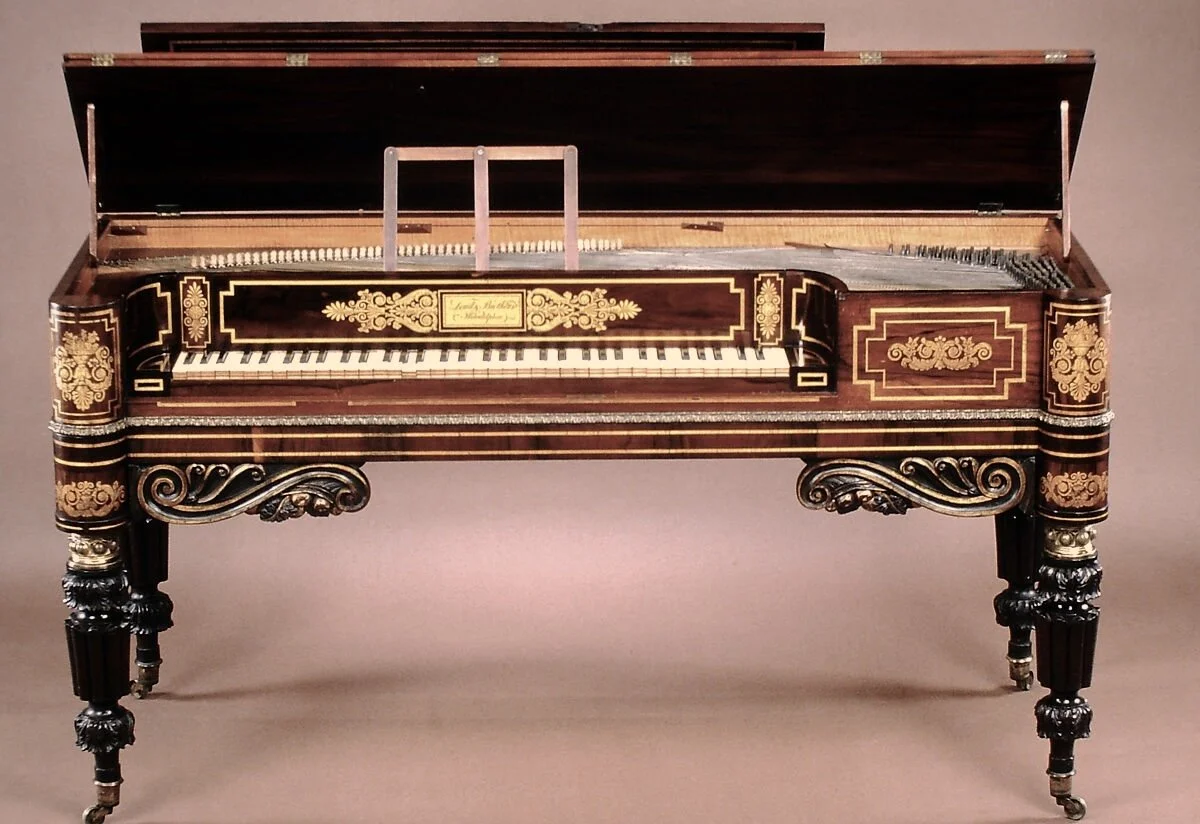
Loud & Brothers, square piano. Photo; public domain.
RAPID EXPANSION
By 1829, over 2,500 pianos were built in the United States, with over 900 pianos manufactured in Philadelphia, 800 in New York, and 700 in Boston. By 1869, about 25,000 pianos were produced annually. There were an estimated 1,800 piano manufacturers in America in 1900, with an annual production of between 170,000 and 180,000 pianos, and by 1905, 261,000 were produced, compromising 50% of all production worldwide.
Piano manufacturing reached its peak of 300,000 to 365,000 pianos annually between 1909 and the 1920s, an era that has subsequently been labeled as the “Golden Age of Piano Making” in America.