

Sight-Reading for Pianists
Practical Tips to Improve Your Sight-Reading
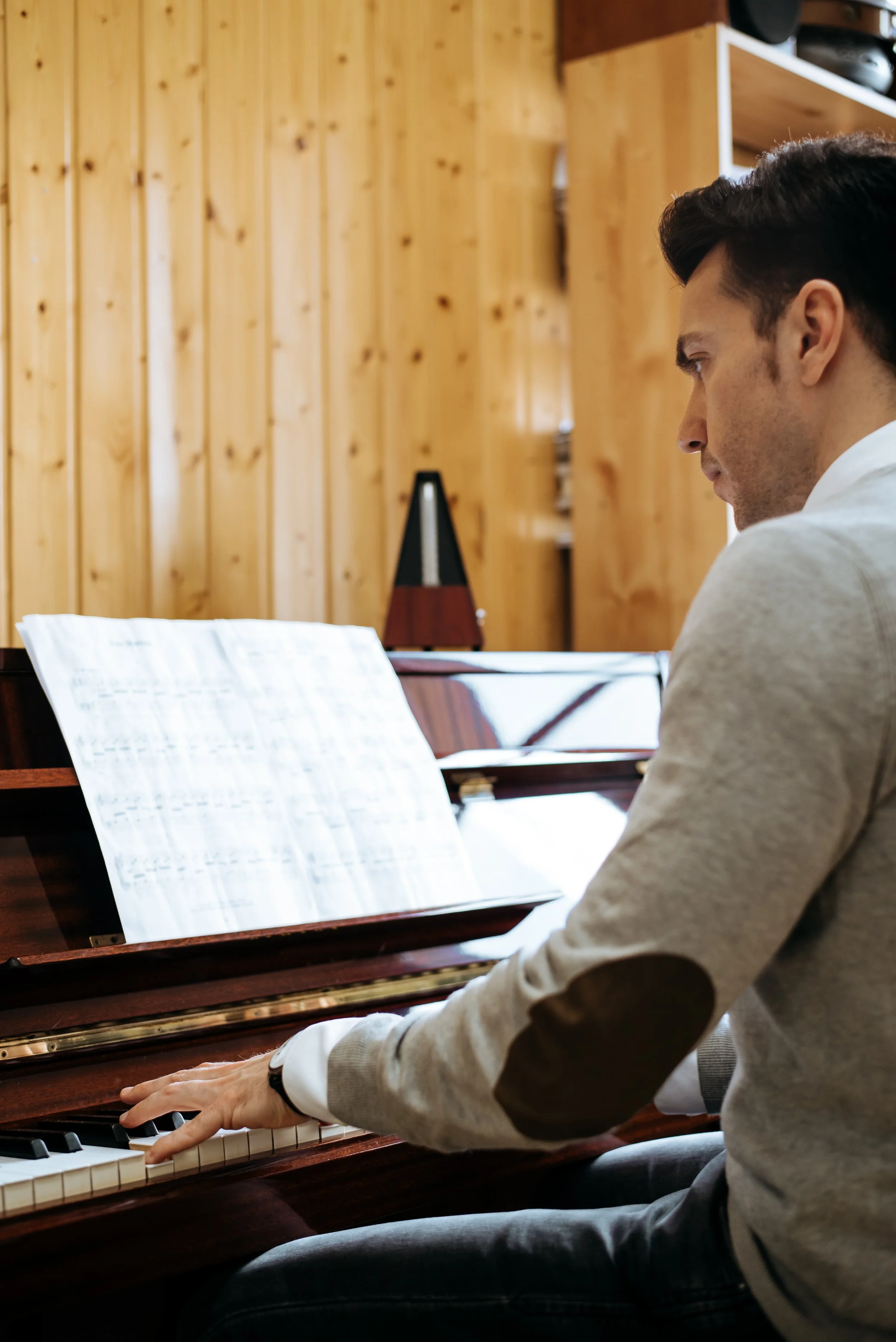
Sight-Reading is an acquired skill anyone can cultivate.
Sight-reading is a great skill for any pianist, enabling you to explore the entire music repertoire firsthand. But many pianists feel intimidated when asked to sight-read, understandably afraid they will play the wrong notes or appear incompetent.
But with the right approach, sight-reading is easier than you may think. There are no secret tricks to sight-reading, but there are tried-and-true tips you can use, and the easier path is often the smarter, more efficient one.
I’ve been teaching piano for over 35 years, and have sight-read in over 2,000 rehearsals with instrumentalists, choirs, and singers while preparing for performances. The practical sight-reading tips below come from a lifetime of professional experience.
In this blog, I’m excited to share a bunch of tips to get you started. So, let’s jump right into it…
WHAT IS SIGHT-READING?
There are a number of music books, as well as videos on YouTube, claiming to teach sight-reading that are actually teaching basic music notation and intervals; but that is not sight-reading. Sight-reading refers to taking a piece of music you’ve never seen before, briefly looking it over, and then playing it for the first time while reading it. The next question students ask is: What music should I use to begin sight-reading?
CHOOSE EASY MUSIC
My first tip is to choose music you can sight-read through without making too many mistakes or constantly stopping and starting. Attempting to sight-read music that is too complex will only lead to tedious hunting and pecking at notes that doesn’t amount to progress. Starting with easy-to-read music is a smarter way to make progress.
If you are a complete beginner or at the elementary level, I strongly recommend using a graded sight-reading series from publishers such as PianoMarvel or Faber. These guide you from one grade level to the next at a smooth and unforced pace.
For those at the intermediate to advanced stages, choose music that is two or three levels below your current technical level. In fact, I encourage you to select music that you think is too easy and start there. That way, you cultivate a confident, free-flowing approach. So if that means starting at the beginner level, that’s perfectly fine. Remember, nobody is watching or judging you.
LOOK FIRST
Once you’ve selected the right level of music for you, don’t play it just yet. Instead, take a moment to scan the piece to get a sense of what to expect; that will make sight reading much easier. When it comes to sight reading, the rule is the same as diving into a pool: LOOK BEFORE YOU LEAP!
Look for rhythmic patterns such as groups of eight notes, or an Alberti bass commonly found in classical music. Look for repeated phrases or a long phrase moving up or down the staff.
KEEP A STEADY RHYTHM
Before playing, observe the rhythm of the composition. In your musical imagination, play that rhythm in your mind, then slow it down a bit; now begin playing into that rhythm without skipping a beat.
At the beginning level, if you need a metronome to stay on track, use one. If you are a beginner using the PianoMarvel or Faber apps or publications, note that they have an internal metronome you can slow down or speed up as you choose. I recommend taking any piece a little slower than you think it should go. When you read through it again, you can increase the tempo.
Keeping a steady rhythm is the first and most important musical skill to develop, and it prepares you for professional rehearsals where a predictable tempo holds the group together and an occasional wrong note here or there isn’t noticed.
PLAY IT AGAIN!
After you play through once, identify and play again any rough spots you encounter to smooth them out, then begin again with a second reading. I encourage students working with me to play through the music not just once, but two or three times. This parlays into what I will call Speed Learning - an invaluable skill in professional performance situations where quick mastery of new pieces is sometimes required.
On a second or third run-through, you can play with more confidence. You could pick up the tempo a bit. If it’s a waltz, now you can give it a more captivating swing and make it truly enjoyable.
AVOID LOOKING DOWN
Students often create obstacles by constantly looking down at the keyboard to find their hand position. But that can make you lose your place in the music; it disrupts the rhythm and can drive you crazy.

Keep your eyes focused on the score, not your hands.
If this is an issue for you, the sight-reading publications will start you in a simple, stationary 5-finger position and then gradually add more notes and new hand positions to build you up. This gets you accustomed to keeping your eyes on the score right from the start.
And when reading more advanced music, if you feel compelled to locate a note two or three octaves away, go ahead and look, BUT resist the urge to move your head and torso in that direction - that’s what causes pianists to lose their place in the music score. Instead, keep your head facing the score; let only your eyes dart to that register of the keyboard. This technique helps you to keep your place in the score so you can continue without interruption.
LOOK AHEAD
Students are often encouraged to look ahead in the music - that sounds like great advice - but look ahead to where?
When you can, give a quick glance to the first beat of the next measure. That gives you advance warning of the direction of the music, and perhaps a change of key signature, or time signature. After a couple of weeks, this habit of quick glances to the right will become second nature, and over time you will be able to take in entire phrases, giving you advance notice of what’s directly ahead.
MUSIC THEORY
Every pianist, classical or jazz, benefits from knowing all the scale patterns so that you can play confidently in any key signature. If you feel unsure about your scales, incorporate them into your daily warm-up routine, and focus on a different scale each day as you play through the circle of fifths.
Every pianist benefits from learning to quickly recognize the basic chords of major, minor, diminished, augmented, and seventh chords. Recognizing chords and chord progressions makes sight-reading much easier.
Recognizing intervals, the distance from one note to the other, is absolutely essential. But a mental concept of intervals is not enough. We must experience those intervals physically in our hands. Only by learning lots of repertoire and sight-reading daily do your hands develop that touchy-feely familiarity for the spatial distances between intervals, as well as the shape and feel in your hands for a variety of chords.
REPERTOIRE
Composers use their hands in unique ways at the keyboard and have their preferred sonorities, or what we call their ‘sound world’. So it’s to your advantage to be courageous and explore all types of music instead of getting stuck in just one style. As you sight-read, you will recognize these different musical configurations, which makes sight-reading easier.
PERFECTIONISM
Pianists raised in a strict classical background often prioritize note-perfect performances, and that’s admirable, but that same perfectionism can lead to fearful paralysis when sight-reading.
In the recording studio, a perfectionist approach is valid, where you can record a piece multiple times to achieve the desired effect. However, sight-reading requires a different mindset that allows for mistakes. So embrace a free-wheeling, adventurous approach to accelerate your progress.
BE GENEROUS TO YOURSELF
Progress in sight reading advances over many weeks and months, just like building hand technique, so don’t judge yourself harshly in the short term - that negativity does not accelerate your progress! Simply show up for the process, include at least 10 minutes of sight reading in your daily practice routine, and if you practice consistently, you will make progress.
BONUS TIPS
A bonus tip: feel free to use plenty of pedaling while sight reading to cover up any awkward gaps in the music that sometimes may occur.
And a second bonus tip: keep your hands and fingertips in very close contact with the surface of the keyboard to maintain that touchy-feely awareness of the spatial distances between notes, especially white to black keys. This will help you go to the next hand position more smoothly.
And a third bonus tip! Often students focus on small details. Ornaments can be tricky and trip you up. So I recommend dropping some ornaments and playing just the primary notes of that melody or chord. Afterward, you can revisit and examine the ornaments if needed.
They say the devil is in the details, and that definitely applies to sight reading, so it’s OK to streamline the music if that is what it takes to maintain a smooth forward motion.
THE GOAL
After several weeks of consistent sight-reading, without fully realizing it, you will ‘turn a corner’ in your progress where sight-reading is no longer a formal study, but becomes enjoyable.
Exploring the piano repertoire through sight-reading is perhaps my most enjoyable activity at the keyboard; I don't feel pressure to be perfect as with recital pieces, and am guided only by curiosity and the pleasure of discovering new music. This is the adventure I want for your journey, too.