

Piano Performance and Stage Fright

Nervousness can become a chronic habit for performers.
How pianists can minimize stage fright and regain personal control.
Was there ever a concert pianist, or piano student, who did not struggle with anxiety before playing for an audience?
And let’s be honest about the plain truth: playing the piano with excellence is an amazing feat of mental focus and complex physical coordination. Top concert pianists command high fees because they showcase phenomenal virtuosity combined with a musical sophistication from decades of intense study.
What is more, a solo pianist, more than any other musician, is performing a high-wire act with no safety net. Unlike a string player in a large orchestra or a singer in a choir, a pianist’s mistakes or memory lapses cannot be ‘covered over’ by all the other musicians around them. You are out there alone and on your own.
And for a piano student at the elementary or intermediate level, the challenges and pressures feel exactly the same for them as they do for a concert pianist.
So, there is a perfectly rational reason for anyone to be apprehensive about playing solo. It is not a defect of personality. But pianists know that extreme stage fright can sabotage an otherwise fine performance by derailing mental focus, resulting in memory lapses or unconsciously causing the hands and arms to tighten, restricting technique.
Almost anything can become a habit—such as smoking, overeating, or endless scrolling on smartphones. Emotional states can become habits, such as those addicted to anger, and pianists can unconsciously develop nervousness as an emotional habit, even when there's no real reason to feel anxious. But, with practice, those emotional habits can be redirected to positive states of mind.
Consequently, every pianist, amateur or professional, needs to develop their own psychological survival strategies to prevent stage fright from taking over and hindering their performance.
Let’s move forward to eleven tactics to gaining control over stage fright…
1. BE PREPARED
The top mistake to avoid is attempting to perform piano music before it is fully learned. This problem is worsened when piano teachers rush students into performances at group recitals or conservatories solely to meet deadlines.
Many adult amateur pianists who have auditioned to study with me state that they quit lessons in childhood due to a trauma resulting from a poor recital performance. I firmly believe that children should not be placed in high-pressure situations that unnecessarily risk their emotional stability - there are better ways to share the musical experience that avoid such trauma.
Attempting to perform a piece that is still technically ‘shakey’ is a guarantee of extreme nervousness. When an adult student began studying with me, and expressed his anxiety to me about a piece he attempted to perform for friends, I validated his fear, saying, “You are not wrong to be anxious; in fact, you have a valid reason to be nervous; you don’t know what key you are playing in, and your fingering has not been worked out at all - you should be nervous! But we can fix that, and we will.”
Nervousness may simply be an alarm bell going off that you are not ready to play this piece in front of anyone, even though you are not sure exactly what the problem is or how to fix it.
2. FINGERING
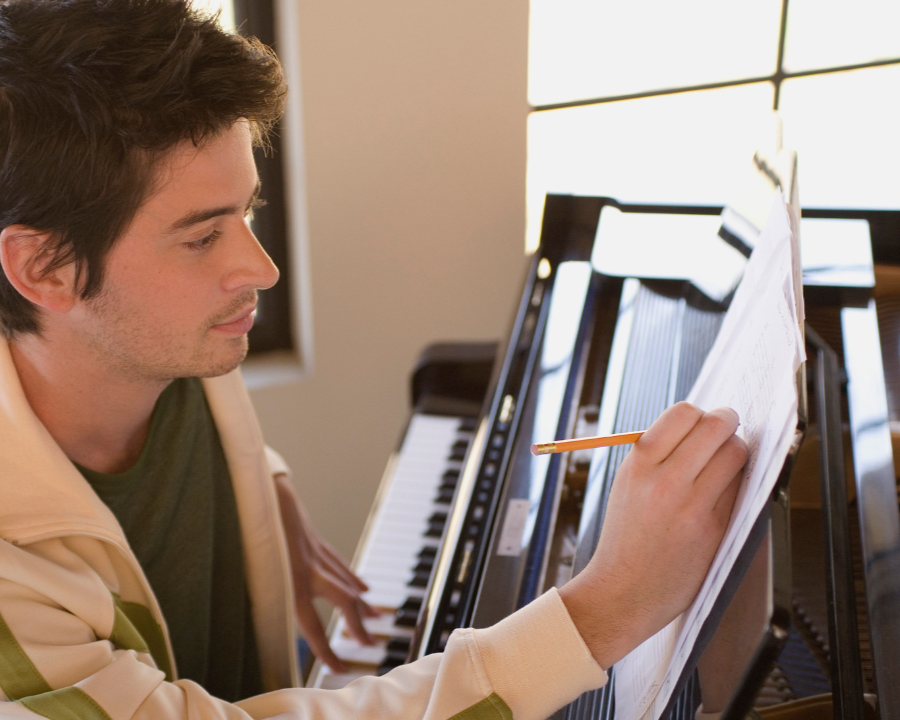
Carefully choose fingering to avoid risky impulsiveness.
Every pianist must carefully work through the fingering of each composition, ensuring that every note is assigned to a specific finger and that hand-wrist positions have been carefully considered.
If the fingering isn't consciously clarified and practiced, the result will be impulsive, random choices, and that risky scenario will heighten anxiety. So, nail down the fingering every time!
3. MEMORIZATION
Memorize the music before playing it for others, even if you choose to have the music up on the rack in front of you as you perform. If we don’t have the music memorized, we cannot claim we know it.
I suggest learning to memorize the music in short phrases, then combining those short phrases into larger sections. Gradually, rehearse the entire piece from memory multiple times. Occasional memory lapses are natural during these formative practice sessions, so keep the score nearby for reference to clarify uncertain notes and secure the music.
4. STUDY THE SCORE
Occasionally, study music away from the keyboard; look through the music score, slowly and calmly, clarifying in your mind the beginning and conclusion of every phrase. Even a little of this type of study goes a long, long way.
Look for patterns, whether they are repetitions of chords or arpeggios, and look for patterns of harmonies, such as a composer spinning through the circle of fifths in a particular section. Identify the sections and frame them in your mind. This is not complicated, and we don’t need to make it harder than it actually is. It does not take much work, and it makes learning go much faster and memorization much easier.
5. PRACTICE PERFORMING
If you can invite a friend to sit down and listen to you play through a composition, it can help condition you to perform for a larger audience. In the process, you may find that during your playing, ‘weak links’ are revealed in places that were not a problem before. Good! Because you can now build them up more securely before playing for a larger audience.
It’s the same for theater companies that first stage preview performances in more obscure locations prior to opening on Broadway - allowing for the process of revisions and correcting unexpected problems before taking it to a larger audience. You are doing the same at the piano by rehearsing the process of performing.
6. RECORD YOURSELF
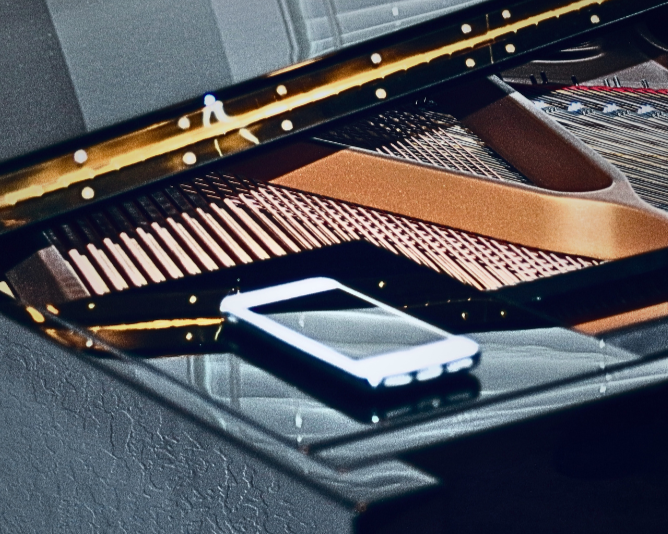
Use any recording device to record your playing.
If playing for friends or family is not practical, performing for a recording device is highly useful. Frankly, playing for a recorder makes me more nervous than playing for a large audience. I can use every device of personal charm on an audience, but that doesn’t get me anywhere with a recording machine that is coldly indifferent and unsympathetic. I often record myself playing through a composition to the end despite mistakes, and I always find many areas for improvement when listening back to the recording.
And a critically important factor: if we always stop to correct every mistake during practice, we train our nervous system to suddenly panic and stop to make corrections during performance, which is the last thing we should do. Even top virtuosos sometimes play past wrong notes or must improvise their way through a temporary memory lapse to regain their place. So, after a piece is memorized, practice playing forward despite errors and resist the urge to stop and fix. Afterward, you can address those problem areas.
Great pianists learn early on to keep playing in performance without making corrections, because stopping will break the flow of the music and will alienate the audience. And some mistakes we make may be less important to listeners than to our own hyper-critical selves.
7. PERFORM ENSEMBLES
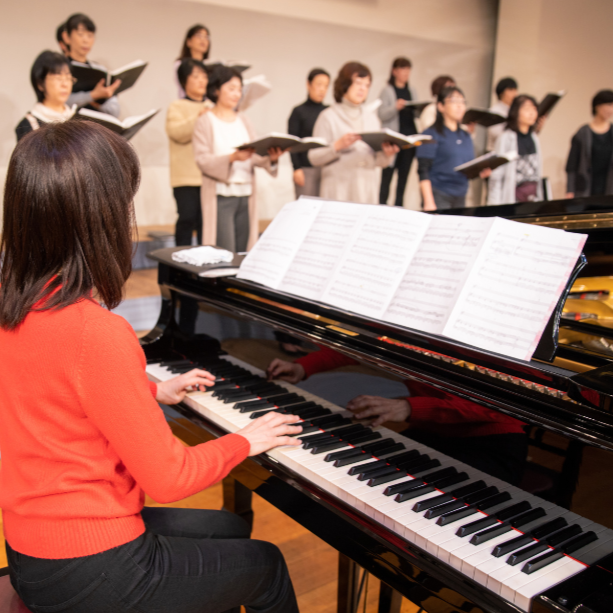
Performing in ensembles helps decrease performance tension.
Regular collaboration with other musicians, wherever possible, is an effective means to downsize nervousness. Accompanying singers, instrumentalists, or choral groups takes the pressure and spotlight off of you exclusive. Yet, it is still an opportunity to perform in front of an audience.
The consistent repetition of rehearsals and group performances will normalize the performing process, and later, when you perform solo you will feel you are on more familiar ground.
8. CHECK THE INSTRUMENT
Never perform music on any piano without first trying out the instrument. A sluggish action, or out-of-tune instrument can disorient even the best pianists. Normally, a performer will have access to the instrument well before a performance. But, even if I am sitting down in a private setting to play for others, I will first take 10 or 15 seconds to play a few chords or arpeggios to gauge how much give-and-take to expect from the keyboard action, and quickly assess the instrument's sonority. That gives a quick warning of what to expect.
By the way, this habit of improvising short preludes, even in public performance, was once common among leading concert pianists in the 19th century and into the early twentieth century. By analogy, you wouldn’t want to dive into a swimming pool without checking how cold the water was.
9. BREATHE

Consciously relaxed breathing helps calm nerves.
When you feel your nerves tightening up, monitor your breathing, as any yoga practitioner does. Consciously take calming breaths, slowly and easily. This helps you regain possession of your body and mind and prevents you from becoming a victim of uncontrolled emotions. In addition, correct your posture by sitting tall, with your chin up and shoulders relaxed while breathing smoothly.
10. CREATIVE TENSION
I remember that in my earlier years, I would consciously accept my nervousness as a ‘companion’, not an enemy. Before walking on stage, I would say to myself, as if my nervousness were a second self, “OK, let’s go out there, you and me together, and deliver the performance!” Rather than pretending to be in denial of the obvious, I accepted that it was normal to be revved up like a racehorse at the starting gate. And I should be. I refer to this as creative tension. After all, a pianist who is not somewhat wired up for action is probably a rather dull pianist.
11. SHIFT YOUR FOCUS
You can repeatedly shift the focus away from the anxious ME and redirect it toward embracing the collective US. Choose to generously accept your audience as friends, even if you have never met them before. Affirm that you love this music, and you love to share it with everyone, like sharing a banquet dinner.
Even one wrong note can be annoying to a performer. However, the greatest concert pianists in history, like Franz Liszt, Anton Rubinstein, Paderewski, Horowitz, and Arthur Rubinstein, were never known for being flawlessly note-perfect, and it didn’t seem to bother them because they were focused on making music come alive to their audience, and that made them persuasive performers. So, if you drop a note here or there while playing, remind yourself that even the greatest virtuoso pianists are still human.
Let’s quickly review how to minimize stage fright:
1. Learn the music thoroughly before performing it for others.
2. Always write down in detail the fingering.
3. Occasionally read through the music score away from the keyboard to reinforce your learning.
4. Memorize the music and practice frequently from memory.
5. Practice performing for a friend if possible.
6. Record yourself playing several times without stopping, only making corrections afterward.
7. Perform with other musicians in ensembles whenever possible.
8. Briefly check the piano in advance to assess its action and sound.
9. Calm and conscious breathing helps regain personal control of body and mind.
10. Accept creative tension and a normal and healthy process for a performer.
11. Shift your focus away from self-doubt, redirecting it toward sharing music with others.